AI-guided intervention design
AI, design, and technology approaches that inform intervention decisions, including target and component selection, dose, timing, adaptation, and delivery.

Research Award Program
The Stanford AITC supports investigators and multidisciplinary teams advancing AI- and technology-enabled precision interventions for older adults, including people at risk for or living with AD/ADRD.
The 2027 AITC Annual National Research Award Competition, supported by the National Institute on Aging (NIA), is now open. The Stanford AITC is one of five participating centers in this national initiative, advancing AI and technology to improve precision health and personalized interventions for older adults, including those living with Alzheimer's disease and related dementias (AD/ADRD).
Each AITC sets its own priorities. These are ours.
AI, design, and technology approaches that inform intervention decisions, including target and component selection, dose, timing, adaptation, and delivery.
Digital tools and models that link cognition, mobility, and daily activities to intervention mechanisms, target engagement, and response.
Health technologies that adjust support as older adults' needs and abilities change, designed for real-world use.
Translation of precision interventions into real-world care, with attention to AI safety, privacy, accessibility, and human oversight.
Computational approaches to identify mechanisms and intervention targets in aging and AD/ADRD.
| Research projects | Non-clinical trial | Clinical trial |
|---|---|---|
| Budget | Up to $200,000 in direct costs | Up to $300,000 in direct costs |
| Project period | Up to 24 months | Up to 24 months |
| Number of awards | Approximately 60 across all AITCs | Up to 5, one per AITC |
Applications are welcome from eligible U.S. academic institutions, healthcare organizations, nonprofits, startups, and industry partners. An applicant may submit more than one letter of intent if each one describes a distinct project.
| Date | Milestone |
|---|---|
| October 19, 2026 | RFA released |
| October 30, 2026 | Letter of intent portal opens |
| November 3, 2026 | Letter of intent informational webinar, 1:00 to 2:00 p.m. Pacific |
| November 16, 2026 | Letter of intent due, 5:00 p.m. Pacific |
| December 15, 2026 | Invitations to submit a full application |
| January 22, 2027 | Full application due, 5:00 p.m. Pacific |
| Spring 2027 | Finalists notified; awards pending NIA approval |
| Summer 2027 | Anticipated project start |
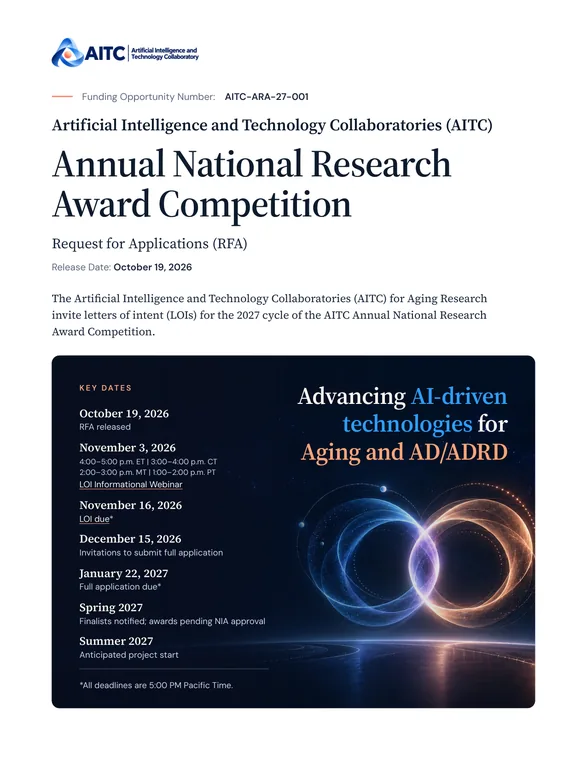
Request for Applications
The full call: eligibility, review criteria, budget rules, and what a letter of intent has to contain. Released October 19, 2026. PDF, 16 pages, 2.2 MB.
Questions about the Stanford AITC's priorities or about applying through us: suaitc-admin@stanford.edu. Questions about the competition itself go to the AITC Coordinating Center at aitcc@yale.edu.
Community
The Collaboratory's work is shaped by the people it is meant to serve. A Community & Stakeholder Advisory Panel of older adults, family care partners, professional caregivers, and community organization leaders advises on study design, recruitment, usability, and dissemination.
Mailing list
Receive updates on research activities, events, and funding opportunities from SU-AITC.
Contact
Stanford AITC
1070 Arastradero Rd
Palo Alto, CA 94304